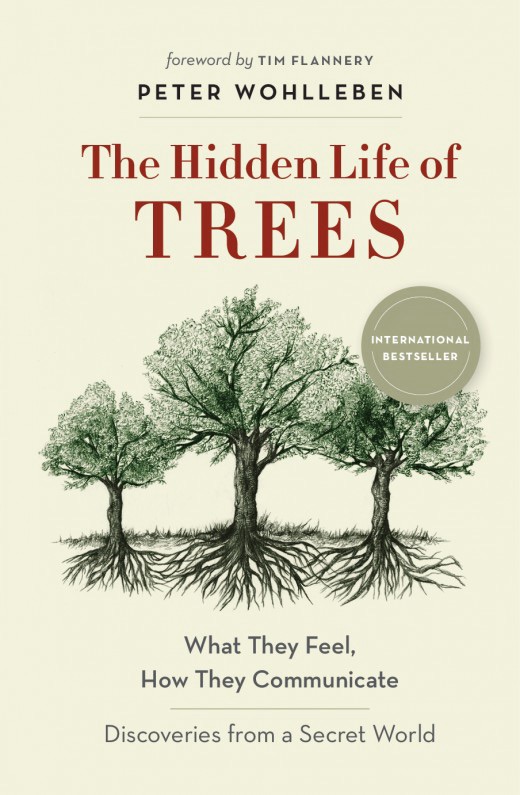
The Hidden Life of Trees by Peter Wohllben. Much of the information in this article is based on research from this amazing book.
This article is 100% human-written. And remember, if you see an error, that’s what makes us human. Subscribe and share.
When you saw the title of this article, you undoubtedly thought, “Mmm. Trees are already free”, but you curiously clicked anyway. Every day, you walk down a treelined street that enhances the reds and blues of the houses behind. Those trees, most encased in concrete to keep from piercing pipes, are not free. Trees are more alive than what you think, and here are the four reasons we should set them free.
They Have Families
I recently began listening to a book called The Hidden Lives of Trees. Written by the manager of a forest in Germany, the author paints a species that feels pain when it’s attacked, feed the hungry and communicates with their community to support it.
In the previously mentioned book, the author tells of a tree stomp that has been alive for decades, even without having an actual tree attached. By all accounts, the stomp should died decades ago, but it thrives because the surrounding trees send nourishment by way of roots. That brings us to the “socialness” of trees.
Trees Scream
Trees are social creatures, who survive by contributing to their surrounding environment. When certain trees are attacked by bugs or nibbled on by animals, they send out scents carried by the wind that warns the others. This gives the other trees time to react, and sometimes creating chemicals that keep away bugs or animals. Also, when they’re in dire thirst, they “scream”.
Trees don’t have vocal cords, but they do vibrate. This vibration is described as a “scream” by the author of the previously mentioned book. At times when they are in a drought, they send out high frequencies, either as a scream for help or to warn others. This is both intriguing and heartbreaking. It makes you want to water a tree.
Also, in undisturbed forests across the world, trees reach heights of hundreds of feet. Left alone, they grow wide, tall and deep. Their roots are unrestrained, leaving them to seek out the most nutrient-rich path.
The trees on your street are no more than 30 — 50 feet. Outside of their natural habitat and encased in concrete in most instances, they will never become the giants their cousins of the forests are. They’ll wither away long before they reach a fraction of the age the free ones will. Without space and a community to lean on in hard times, these trees are no more than caged beauties.
Trees Sustain Ecosystems
When you step over a fallen tree in the forest, you probably see it as just a piece of wood covered in ants and patches of moss. That tree is actually food, shelter and life for hundreds of animals and other lifeforms. It is as vital to life as the live tree.
Forests are valued because they absorb carbon dioxide and release oxygen. In a way, they purify the air we breathe. Without them, society as we know it couldn’t exist. Air would be scarce, and with nothing to prevent them, landslides would be inevitable. Marine life would suffer from the runoff, and so would humans.
They’re Majestic
What do we know about trees? What can we detail about their hundreds of years of existence? At over 4,854 years old, Methuselah — located in the Inyo National Forest White Mountains in California — is the oldest tree in the world. It has been around nearly as long as written language. We don’t know and will never know what this tree has witnessed.
Just like humans, trees are individuals. Yes, they thrive together, but as Methuselah proves, their destinies are not the same. When we uproot a tree or plant one in an unnatural habitat, we hold it against its will. We control its destiny, robbing it of the ability to grow old and become beautiful. It will never realize its prime. Because of this, we owe it to these trees to set them free and let them live the life nature intended.
This article was written by Jermaine Reed, MFA, the Editor-in-Chief of The Reeders Block.
Discover more from The Reeders Block
Subscribe to get the latest posts sent to your email.
 The Reeders Block