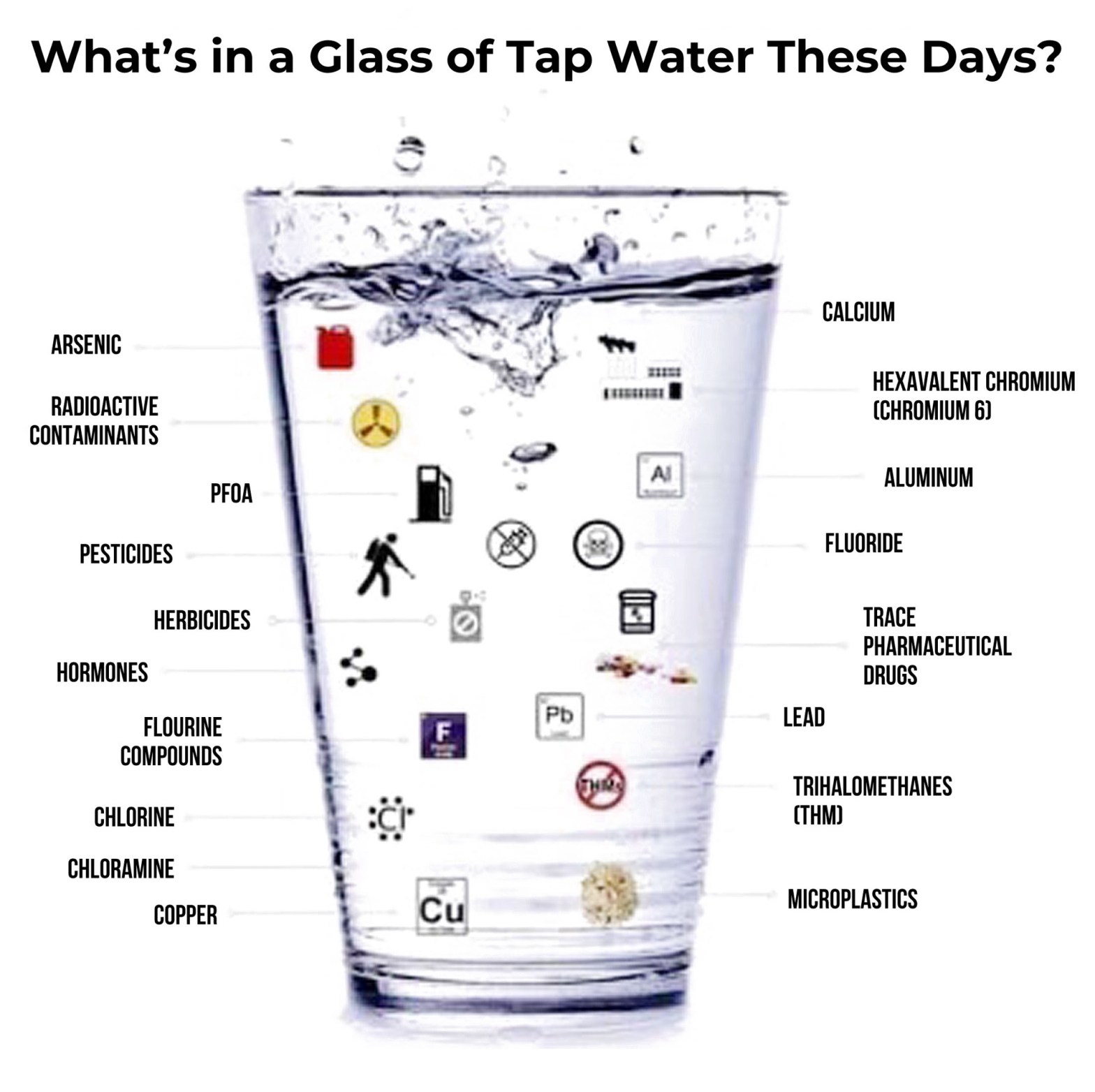
Photo from PureWaterChanges.com
Although it is generally accepted that tap water is as safe as bottled water, tap water travels miles through pipes that haven’t been changed or cleaned in decades. Before it reaches your home, it’s intentionally and unintentionally mixed with chemicals which are increasingly pharmaceuticals. With people taking in these chemicals through their water every day for a lifetime, the buildup of these toxic substances in organs and muscle tissue may prove to be more detrimental over time for people and developing fetuses. As more chemicals appear in drinking water at higher levels, developmental disorders like Autism Spectrum Disorder (ASD). have increased 175% over the span of a decade, according to AutismSpeaks.org. Doctors and scientists have no answers but have ruled out needles as the primary cause of ASD. In times like these where there is an increase in disease or disability with unknown causes, it’s important to recall how water played a part in past epidemics and to examine what is exactly in the water we drink and where it comes from.
Tap Water Chemical Bomb
A local government agency usually maintains water pipes through pressure monitoring, leak detection, chemical treatment, pipe flushing and pipe replacement. The average pipe system in America is on average 45 years old. It’s been estimated that most water pipes need to be changed once every 75 to 100 years. A majority of pipes systems are reaching the end of their suggested lifetime, and it is time to start factoring in the ailments these pipes may be causing. We should also be questioning why government officials are thinking about recommending safe drinking level limits for body care products in water.
If someone handed you a cup of water and told you it had just a little bit of shampoo in it but was still safe for you to drink, would you drink it? Currently, there is a debate as to if the EPA should create standards for safe drinking levels of personal care products in water. This is simply to address an issue that exists and to set limits.
According to the EPA, the organization “has not determined whether standards are necessary for some drinking water contaminants, such as personal care products. Personal care products, such as cosmetics, sunscreens, and fragrances; and pharmaceuticals, including prescription, over-the-the counter, and veterinary medications, can enter water systems after use by humans or domestic animals and have been measured at very low levels in drinking water sources.”
As cited above, personal care products, pharmaceuticals and even veterinary medications have been found in drinking water. It is a cocktail of toxicity. Reading the labels of any of these products will tell you in no uncertain terms that these products are not for consumption or ingestion. They also offer a poison control center number somewhere on the packaging. The EPA is considering setting safe drinking level limits for these chemicals in water, and that’s a start. Maybe it will prevent, for instance, vaccine dumping into water systems. But it does not stop those chemicals from leaking into drinking water systems in the first place or prevent them from building up in the organs and muscle tissue of moms, dads or children who drink it.
Read or DOWNLOAD your copy of the Truth Be Bold Newsletter, featuring the BALTIMORE MOM who says she killed her 11-year-old daughter for “having…”
The EPA further stated, “Many concentrated animal feeding operations treat livestock with hormones and antibiotics, and can be one significant source of pharmaceuticals in water. 35 Other major sources of pharmaceuticals in water are human waste, manufacturing plants and hospitals, and other human activities such as showering and swimming. Any potential health implications of long-term exposure to levels of pharmaceuticals and personal care products found in drinking water are unclear.”
Part of the above quote from the EPA says, “Other major sources of pharmaceuticals in water are human waste…” The first question is, how does human waste end up in any drinking water? Waste water is usually “disinfected” and dumped in a different body of water that takes it away from the intake water source. Obviously, it’s not a perfect system. But pesticides remain at detectable levels in tap water, and it is a known fact that pesticides can cause ASD. By drinking tap water, you or your family risk drinking human waste, pet medicine or a cocktail of toxic chemicals.
A Rise in Illnesses
The number of children and adults diagnosed with Autism Spectrum Disorder (ASD) increased over 175% in a decade, and no doctor or scientist knows the primary cause. Heavy metals and chemicals can cause developmental delays and can be dispersed through water systems. It’s beneficial to recall the havoc a contaminated water source can create.
In 1854, 600 cholera deaths occurred within a ten-day period in London, and Dr. John Snow, an obstetrician and anesthesiologist investigated them. Until this point, there had been a significant number of cholera outbreaks across the world, but no one had found the cause. In London, where John Snow lived, the disease was even more pronounced, but he was determined to find the cause.
During his investigation, Snow found that the outbreak started in a tight area. He observed that all of the deceased drank from a common water source which was the Broad Street pump. This gave him an inclining that something was amiss in that area. But he needed a control group to prove that the Broad Street pump was causing illness.
Other News: Read this article about looking younger by getting your daily intake of COLLAGEN from natural foods.
Doing more research, Snow found that those who worked at the town’s brewery or lived in “poorhouses” did not get sick. They also drank from local wells and not the Broad Street pump. Snow concluded contamination at the Broad Street pump caused the deaths, and he persuaded public authorities to remove the handle from the pump in an effort to avoid further cross-contamination. The officials didn’t automatically buy into this reasoning, but they did change the handle. It was a quick, simple fix that cost a fraction of what another outbreak would. Within a few days, the epidemic cleared up.
To be sure, ASD and cholera are not the same at all. ASD is a developmental disorder, whereas cholera is a disease caused by a bacteria. The previous example is used only to show how a contaminated water source can spread disease. Knowing that, it’s accepted and known that tap water is sometimes contaminated with metals, chemicals and, now, personal care products and horse medicine. We do know that alone, if anybody ingested any of these chemicals over even a short period of time, they would suffer illness or death. What we remain unsure of is the longterm effects of these substances after building up in the organs — including the brain — or muscle tissue over a longer period of time through drinking water.
A person can argue that we all drink the same water and just a small percentage suffer from developmental disorders. Therefore, it’s more plausible there is another culprit to blame. Ten years ago, that would have been a strong argument. Within a ten-year timeframe, as noted, ASD increased in adults and children 175%. Some would contribute that to better access to healthcare and doctors’ ability to diagnose the disorder. With the numbers soaring almost 200%, that argument is weak at best. To argue it with a straight face, a person would have to concede that doctors somehow became 175% better at diagnosing ASD in ten years or some other unlikely miracle. That’s not a plausible position.
A Note on Bottled Water
Bottled water can be a better alternative to tap water, but it has its own drawbacks. It comes in plastic, and the water within it likely contains microplastics which can buildup in tissue or organs as well. Some studies have shown microplastics caused inflammation and neurotoxicity in human cells. These are mostly early studies but are worth delving into when making a decision between tap water and bottled water. For those environmentally-conscious people, bottled water isn’t worth the waste it leaves behind. For them, there are different types of water filters.
The Takeaway
Tap water isn’t as safe as some think it is. There have been pharmaceuticals, horse medicine and personal care products found in drinking water. The EPA is considering setting standards to indicate safe levels of personal care products in water. This may prevent water from becoming significantly contaminated with those products, but it doesn’t prevent those products from being in your drinking water. The longterm effects of consuming that contaminated water are unknown. What is known is, ingesting personal care products or horse medicine is unsafe and harmful. Bottled water has its own drawbacks, but it nay the safer alternative to tap water for the time being.
This article was written by Jermaine Reed, MFA, the Editor-in-Chief of The Reeders Block. He also works an Adjunct College Professor. Join the email list to get notifications on new blog posts and books. This article is 100% human-written. And remember, if you see an error, that’s what makes us human.
Nothing in this article should be or is meant to be taken as medical advice.
Discover more from The Reeders Block
Subscribe to get the latest posts sent to your email.
 The Reeders Block