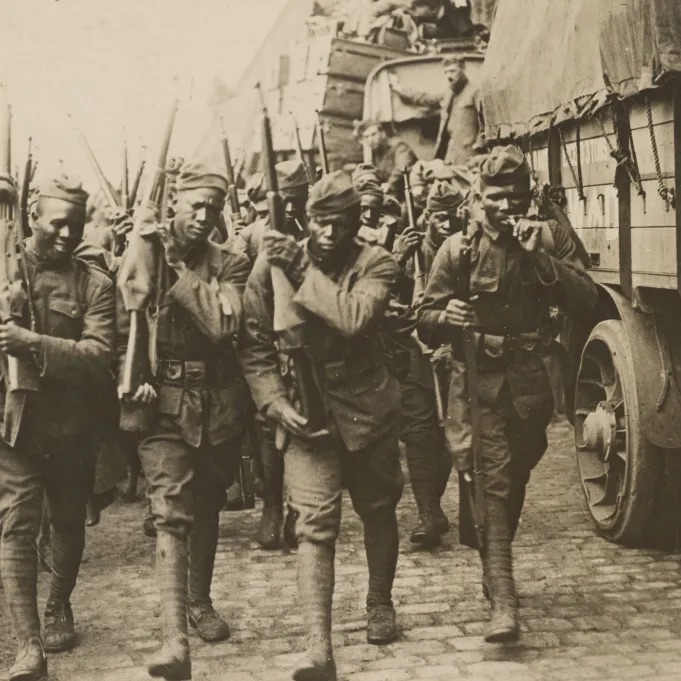
A photo of African American soldiers in the Great War. Photo taken from Unwritten Record.
On June 19th, 1865, the Union Army marched into Galveston, Texas, and announced to the town that all enslaved people were free. This date is important because it is after the Emancipation Proclamation which freed slaves in all revolting states (but not in non-revolting states) on January 1st, 1863. Juneteenth was also after the Civil War had ended in April 1865. Because of this, Juneteenth is more than a holiday. It is a record.
Keep Your Slaves but Pay Your Taxes
The Civil War was about taxes and not the morality of slavery.
“I have no purpose, directly or in-directly, to interfere with the institution of slavery in the States where it exists. I believe I have no lawful right to do so, and I have no inclination to do so,” Lincoln said in his first inaugural on March 4th 1861. Lincoln also owned slaves. One can argue that it was normal at the time, but morality has no timeframe.
Abraham Lincoln’s overlooking such a horrific institution for taxes correctly reflects the ideals of the American government.
The Civil War started because the North had become industrialized and relied less on slave labor, but the country wanted more taxes on slavery. The South was economically booming from free slave labor. The fifth paragraph of Lincoln’s First Message to the U.S. Congress reads, “My policy sought only to collect the Revenue (a 40 percent federal sales tax on imports to Southern States under the Morrill Tariff Act of 1861).” He wrote this July 4, 1861, Independence Day, to declare he had no interest in ending slavery. He just wanted the taxes.
Abraham Lincoln’s overlooking such a horrific institution for taxes correctly reflects the ideals of the American government. As an example, the IRS has declared that even if you are getting money illegally — i.e. selling drugs, trafficking weapons, or otherwise running a profitable crime syndicate — you must declare your earnings and pay taxes on your ill-gotten gains.
“Also, I lost two kilos of cocaine. Is there a deduction for that?”
I can’t imagine a drug smuggler filing taxes and saying to his tax preparer, “Also, I lost two kilos of cocaine. Is there a deduction for that?” I’m not sure of the process, but if a crime boss does pay taxes on admittedly dirty money, does the IRS refer that person for criminal charges? Or do they look the other way because the dealer is contributing taxes and, therefore, contributing to the growth of society? I don’t know. It’s complicated at best.
The Takeaway
While Americans celebrate the country’s freedom on July 4th, African Americans celebrate their freedom on Juneteenth. America claimed its freedom on July 4th, 1776, about 89 years before the last of the unjustly enslaved were freed. Juneteenth is a reminder of that day. It is a reminder that even the most basic human rights for African Americans come later than it does for others.
We live in a country that wrote and declared that all men are created equal and have a right to life, liberty and the pursuit of happiness. And then those same people not only enslaved others but led the most brutal form of slavery this world has ever seen. This country did not go to war over the morality of slavery. It went to war over taxes, money. The Freed People of Galveston, Texas, received the message of their freedom on June 19th, 1865. That is not only when the last of the enslaved people were freed but when the country itself was freed — whatever “freed” actually means in part for a people who continue to face oppression.
This article was written by Jermaine Reed, MFA, educator and the Editor-in-Chief of The Reeders Block. Join the email list to get notifications on new blog posts and books. This article is 100% human-written. And remember, if you see an error, that’s what makes us human.
Discover more from The Reeders Block
Subscribe to get the latest posts sent to your email.
 The Reeders Block