
Photo from Forbes.com.
NOT tO Be A MiCR0ManAGER, but SUBSCRIBE for the strategies you need to manage up, push back and reclaim your peace of mind at work. This article is 100% human-written. And remember, if you see an error, that’s what makes us human.
Nobody likes a micromanager, especially one that doesn’t know boundaries. You have enough stress at work, and micromanagers can make it 10x more stressful. Before you allow them to run you up a wall, read the following tips on how to effectively manage a micromanager.
Control Your Workflow
Micromanagers are annoying, and they nitpick about everything. If you start work at 7:30 am, it’s not uncommon for a micromanager to message or call you by 7:32 am. They leave you barely any room to breathe. For your own sake, control your workflow.
Regardless of what a manager thinks, you don’t have to reply instantly to their messages or calls. On those high-stress days, it does you no good to divert your attention to a naggy manager. Generally, you should set a time to read and reply to messages.
To effectively lower your stress, set a specific timeframe for each day to read anything that came through. This compartmentalizes your communications and streamlines the energy it takes to reply to them. When you reply to messages randomly as they roll in, you open yourself up to more stress.
As you know, if you’ve ever read an email from work, there is usually a deliverable attached. The sender wants you to do something. If it isn’t that, they have a question, and this question takes some research or reaching out to other coworkers.
Many times, when these messages arrive, you’re already in the process of doing something else. Then, you drop it to do whatever the email asks and forget to come back to it. Don’t do this. Setting an hour or two aside each day works better.
Additionally, if you are using Teams, you can set your status as “Busy” or turn on “Do Not Disturb.” These features, along with managing your calendars, let people know when you’re busy. They also prevent interruptions which lowers your stress. So, do take control of your calendars, availability and communication methods. Manage your workflow, and when that doesn’t work, push back.
Push Back
Ironically, the one thing about micromanagers is that they aren’t usually very good at their own jobs. For instance, an assistant principal micromanaging a bunch of teachers might be distracted enough to miss a deadline for filing a report. Undoubtedly, micromanagers will make errors, and this opens up the greatest opportunity to push back. But how do you do this?
One way to effectively push back is keeping your communications and presenting them when your manager says something that conflicts. Let’s imagine a scenario where a tutor’s manager emails the tutor saying, “We don’t tutor English-101.” The tutor tells this to a student who complains to his advisor. The advisor escalates the complaint to the Dean of Instruction, and that Dean says the college does tutor English-101. When it gets back to the tutor, the tutor can present the email showing his manager said they didn’t tutor English-101. This does a lot.
Most importantly, it puts the manager on notice that the tutor is paying attention and keeps evidence. The manager will rethink what they say to the tutor and how they say it. Still, you should keep all of your written communications and get as much in writing as possible.
Also, having your manager’s bad information in writing protects you. Sometimes, you think your manager is wrong. But it is uncomfortable to tell them that, and doing so isn’t your job. They are the manager in the leadership role. You should be able to rely on their leadership. When they fail you, the best thing you can do is have evidence, primarily in writing.
On that note, save all of your emails, messages and other written communications. They will act as your evidence and paper trail documenting your claims. Create folders for these communications, and label them properly. Keep these folders on your personal computer or cloud account. Do not keep them stored in your work computer or work cloud because your employer has access to them, and they don’t need your permission to skim through them. If you ever have to go to HR or your union, these communications will be the most instrumental part of your claims. But should you ever just let your manager know what’s on your mind?
But what about talking to the micromanager?
Ok. You got me. You’ve noticed there is no section on directly talking to a micromanager. The reason is, some micromanagers are unreasonable, and this can be dreadfully awkward. Trying to talk to some of them is no different than speaking French to a wall with a face with no ears. Still, directly talking to a micromanager can be helpful. If you insist on doing so, here’s how.
In moments where your manager asks, “Is there way you prefer to communicate?” do tell them. This isn’t the time to be shy. They asked, and now you have a reason to say what’s on your mind.
Before speaking to them, what would you want to say to them? How would you say it? What is the most pressing issue, and what can your manager to do to help solve it? You need to answer these questions beforehand.
When you are prepared, your nerves are under control, and you know what you’re going to say. Speak on the most pressing issue or two. Don’t go in with a scroll. You’ll look like just another complainer if you do. Have your talking points clear and ready to go like an elevator speech. Use euphemisms. “I communicate better through email” comes off better than “Don’t call me. Send an email.
However, there are times when you have to broach the subject without invitation. It may just be an uncomfortable situation for you. Sometimes, the best way to set boundaries is with instant action. In these instances, do it right then in the moment. You have to check it immediately.
If your manager breathes over your shoulder as you type or sits too close, scoot over some. They’ll get the picture. Boundaries are important, and you have to set them clearly. Even then, some micromanagers won’t get the hint, and then you have call in reinforcements.
Seek Union or HR Advice
Your union or HR department will not be able to help you all the time, but where your manager violates a policy or law, these are the people to turn to. Your union is your voice, and you should always start with them. If something is legally wrong or sketchy, their interest is in protecting you. HR is not the most helpful in most work conflicts, but when something is truly wrong, they can take care of it quickly. Before going to your union or HR department, do some research.
Start with reading your formal job description. Compare what it says to what you actually do. Is there a discrepancy? Read your union contract. Know what you are claiming, and be familiar with what kind of violation your manager is probably committing. You don’t have to start citing sections and clauses of your contract. You do want to be clear that it may be at least some kind of violation.
To be careful, frame your claim as pointed question. Am I required to respond to my manager after work? What should I do if manager is micromanaging me?
Micromanaging can also be mismanaging. Has your manager asked you to do something illegal or against company policy? Is your manager creating a hostile work environment? Have they threatened you?
If you are in a union, your contract may require you have a union representative present whenever you are being disciplined, even if it is not formal. So, when a manager makes a threat or you feel as if you are being disciplined and you didn’t have representation, talk to your union.
Your union can’t solve every problem, but it can solve some of them. Unions can give you guidance on what to do next or just be there to hear you out and ensure your rights are not being violated. This relieves some of the stress by informing you of your feasible options and how best to move forward. When you’ve exhausted the options best for you without a good outcome, your next step is stepping to the nearest exit for good.
Quit.
The easiest way to deal with a micromanager is by quitting or moving to another position within your company or organization. This can be easier in theory than in practice, but it is possible. The first thing you want to do is update your résumé and cover letter.
Depending on how long you’ve been at your job, you probably haven’t updated your résumé for months or years. This is your reminder to put all of your new experience and skills on your résumé. Update it with any new education, licenses or certificates as well.
Also, proofread, edit and revise your résumé. You can do this in Microsoft Word with the assistance of its Ai Copilot. DeepSeek and ChatGPT can help you with this as well. However, Ai tools can miss some errors or provide erroneous feedback. So, be sure you or someone you trust checks behind the Ai for any missed errors. You want to follow this same process for your cover letter as well.
On the topic of cover letters, do provide one when you can. After Googling “Do I need a cover letter?” you might get more nays than yays. Provide a cover letter. Don’t be like everyone else. This will set you apart from other applicants with like experience or skills. After doing all of this, start applying.
Now, you might get stuck asking yourself, “What job should I apply for?” The real question is, what do you like to do? Ask yourself, why am I unhappy in this current position, and how do I change that?
If you are applying for new jobs to get from under a manager, you should apply for an internal position in a role the manager you currently have doesn’t manage. This will likely require you to change positions completely. If so, what are your skills? How can those skills be transferred to a different position in your current company? And what positions are presently open?
However, if you are applying outside of your organization, you will find more opportunities for the same position you currently hold. The difference is, you’d be at a different company or organization. Changing workplaces can be stressful and come with its own complications.
If your manager stresses you, this change might be worth the initial stress making the move can cause. Whether you are applying internally or outside of your company, start applying. Your mental health matters, and micromanagers are not good for you.
The Takeaway

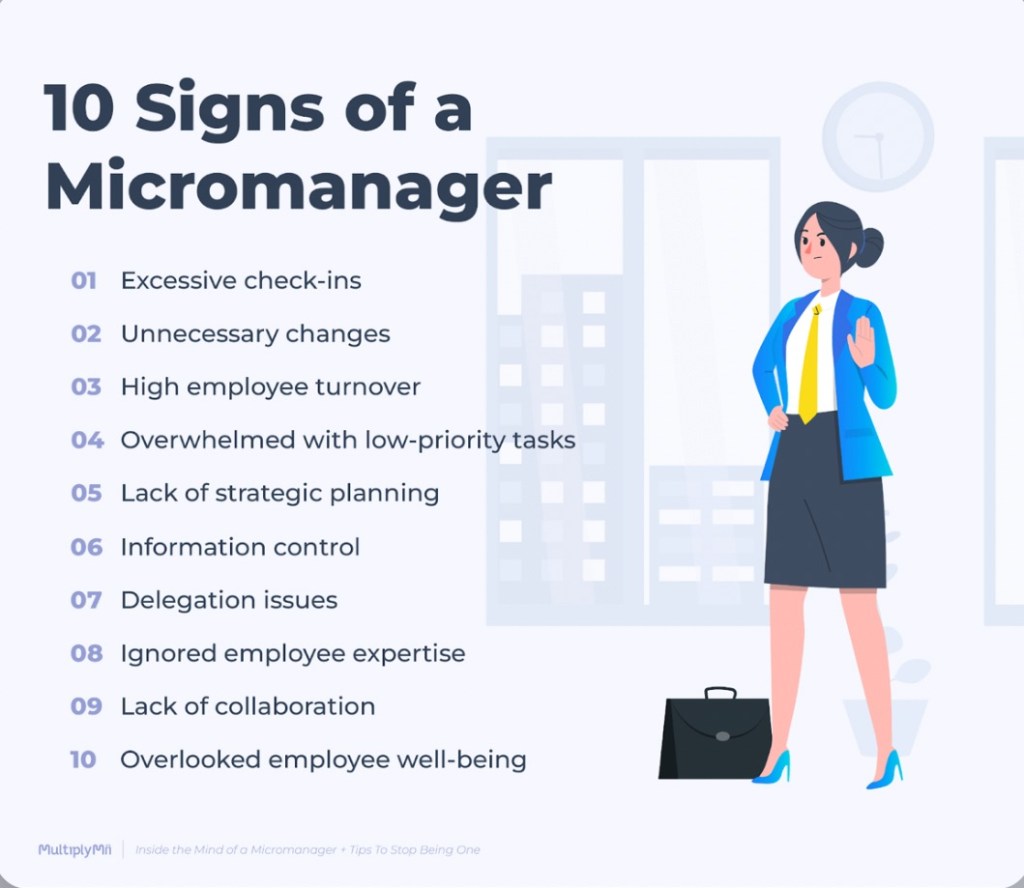
Micromanagers are stressful, and dealing with them is really about reclaiming your autonomy. You are not powerless. In fact you are powerful. Therefore, protect yourself, communicate what’s on your mind, escalate when necessary or simply walk out the door. Taking any of these actions requires forethought and grace. Remember, you are not beholden to anyone, and you can start exercising your options now. Read 3 Pro Tips to Create a Résumé that Gets You a Job Interview to start making moves immediately. Also, check out the picture below to see if your manager is a micromanager.
This article was written by Jermaine Reed, MFA, the Editor-in-Chief of The Reeders Block.
Discover more from The Reeders Block
Subscribe to get the latest posts sent to your email.
 The Reeders Block