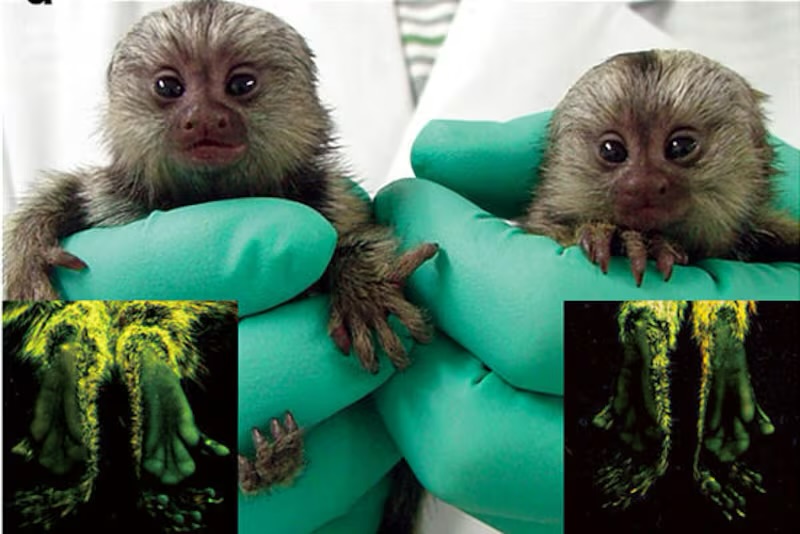
Photo from Deseret.com.
SUBSCRIBE to TheReedersBlock.com and follow for more news on shady, real-life science experiments. This article is 100% human-written.
In 2020, distressed scientists ended the lives of a number of marmosets with human-like brains after delivering them through cesarean section. This was a somber ending to multi-year study into human consciousness and a human gene known as ARHGAP11B. Scientists expected some results, but they didn’t expect to actually replicate consciousness.
The Genetic Typo
Wieland Huttner, Marta Florio and their team of researchers had a problem. They couldn’t understand why human brains were triple the size of chimpanzee brains, even though our DNA is 99% the same. So, they did some research, before testing their theories. What they found was a genetic mutation that gave our brains the ability to make us human.
Shortly after humans split from the lineage of chimps, a glitch happened. They still shared the common ARHGAP11A gene, but a genetic typo happened in humans. A gene accidentally made a useless partial copy of itself. The error was purposeless, until a sole “letter” in the DNA changed. For simplicity, there are four “letters,” and they are the alphabet of life. These four letters, A, C, G and T, are like the digital codes of instructions that run computers. In the mutation, something strange happened.
The letter C converted into a G. With this typo came a change in how the gene was read. From this grew a unique protein with 47 amino acids found only in humans. This protein assumed the new role of instructing brain stem cells to keep dividing and multiplying way longer than they do in other animals. The researchers figured this might be why our brains were so much bigger. It was likely but not proven, but they had enough evidence to justify an experiment. So, Weiland Huttner and his team stepped into the lab.
Remembering Existence
Weiland Huttner, director at the Max Planck Institute in Germany, and his team had questions: what caused consciousness in humans, and could it be replicated in other animals? They knew that consciousness couldn’t happen if the brain didn’t have the right tools. That is, it needed to be able to hold memories for more than a few moments. It needed long-term memory. If the researchers wanted to potentially replicate human consciousness, they needed an animal with the ARC gene (Activity-Regulated Cytoskeleton-associated protein).
The ARC gene is the protein responsible for helping the brain decide which memories to keep and which to let go of. Without it, you wouldn’t be you. This gene is often likened to HIV, since it looks and acts like a viral “gag protein”, which is the stuff that forms the outer shell of viruses like HIV. It can actually package its own genetic material into tiny capsules (capsids) and send them from one neuron to another. On top of that, it can rearrange the brain.
When a person learns something new, the ARC levels spike in their brain. It helps physically restructure the synapses (the gaps between neurons) to “hard-code” that information. If the researchers wanted to produce consciousness outside of the human, they needed an animal with the ARC protein. The animal they settled on was the marmoset. That was a tragic error.
Part Marmoset, Part Human. Literally.
Marmosets have their own ARC gene, so they just needed the ARHGAP11B gene. If the scientists were right, the ARHGAP11B gene should provide the hardware for the ARC gene to make the marmosets intelligent. They genetically modified seven marmoset fetuses to carry the human ARHGAP11B gene. The researchers were looking for any success. They didn’t know they would actually create another intelligent species.
At sixteen weeks, the researchers began examining the brains of the seven marmosets. Two seemed normal, but the others made their spines shiver. In five of the monkeys, the “neocortical wall resembled that in fetal human neocortex.” Furthermore, the “marmoset neocortex was larger and its cortical plate thicker than that in normal marmoset neocortex and, in contrast to the smooth surface of the normal marmoset brain, exhibited surface folds.” Summed up, these marmosets had bigger, enhanced human-like brains. They could produce human-like personalities. The researchers absolutely panicked and for good reason.
For the first time ever, another species could ask, “What is my purpose?” or “What is the meaning of life?” Suddenly, the researchers would be keepers of human-like monkeys well-equipped to communicate.
Marmosets lack the vocal cords to speak like a human, and they don’t have the physique for fine motor skills. But with the human gene, they would be able to use sign language or tablets to select words or images to express their feelings. Having a marmoset ask, “Why am I your prisoner?” wasn’t an ideal outcome for the researchers. They had to pull the plug.
So, they performed c-sections to destroy the marmosets, bringing the experiment to an abrupt end. They had wanted to know why the human brain was triple the size of chimpanzees, even though they shared 99 percent of the same genes. What they might have answered is, where does the human consciousness come from? They terminated the experiment before they had to face an answer that would come as a question from a marmoset born prisoner to an experiment.
The Takeaway
The marmoset human gene experiment unethically created marmosets with the software to exist in a body that lacked the hardware. While their brains grew human-like folds, they still had the bodies of marmosets. Imagine being you but trapped in the body of a small monkey. It also raised new existential questions about human consciousness.
If a monkey can essentially be injected with consciousness, how are we truly any different or unique? The difference is, we already have the genes and the physical body built to run them. We weren’t lab-made. Our hardware and software were selected to work together by natural design. This experiment only proved that scientists can create franken-monkeys, tortured by their own trapped existence. Is that really a win for humankind?
This article is based off the study “Human-Specific ARHGAP11B increases size and folding of primate neocortex in the fetal marmoset” by Wieland Huttner and his team. You can read the full original study here on Science.org.
Jermaine Reed, MFA is an educator and the Editor in Chief of TheReedersBlock. Take time to Subscribe. It helps promote independent journalism and my site.
Discover more from The Reeders Block
Subscribe to get the latest posts sent to your email.
 The Reeders Block