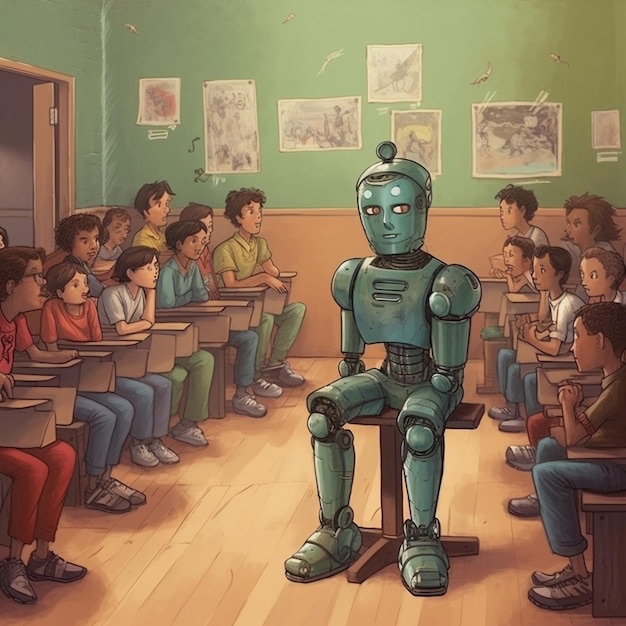
Photo from FreePik.com.
2024 has been an eventful year, from having my car tire disconnect from the joint in a McDonald’s drive thru to ending the school semester having created more great writers through my English-101 course. Although this has been an eventful year, it has also been an insightful one. Never have I been more concerned for the literacy of American youth and first-year college students than I am now as an educator.
No More Writers
With the advancement of AI writing technology comes the very real threat to American literacy and critical thinking, and this is evident in first-year college students. Because they have access to Ai writing tools, too many students don’t see the importance of writing or reading.
Reading and writing are fundamentally linked together and are inseparable from critical thinking. In this context, critical thinking is one’s ability to think about the way they think. In this process, one not only comes to an opinion but evaluates why they came to that opinion.
… reading helps a person retain information and [a book] allows them to highlight examples or points to come back to…
As an example, if a person believes a student shouldn’t eat in a library, they would ask themselves why they believe that. What supporting facts or evidence leads them to this conclusion? This person might have heard a news story about mice in a local library or just think eating throughout a public library could possibly cause vermin. In thinking about this, the person is compelled to do more research and might find that the mice in the local library came from poor construction not food items. Or they might find there are only designated places where students can eat in a library and this accommodates those who might need to eat at specific times because of a medical condition. Alternatively, they might find that the mice in the library are indeed the result of poor eating habits of students, as reported by a credible source.
Moreover, that person might realize they jumped to a conclusion too quickly. They will evaluate their decision-making process and could conclude they need to ask more questions before forming an opinion on a subject in the future. They have taken an effective step towards strengthening their critical thinking process.
In the above example, the person took further steps to gather more information. To do this, the person had to actively look for it and consume the information by reading it. A person could get information from videos. However, reading from a book helps a person retain information and gives them space to highlight examples or points to come back to, while giving them time to process the information.
[Ai has] also disrupted research.
However, Ai hasn’t only disrupted reading, writing and critical thinking; it’s also disrupted research. In order for a student to write a research paper pre-Ai, they had to read books, articles and magazines to gather information from credible sources to support their claims. This interaction with reading, taking notes and researching exposes the student to more information. They now have multiple angles from which to argue.
With Ai, students just write in a prompt or two until the bot gets it right to their standards. The student skips reading, writing, researching and critical thinking. They essentially do no work. This is troubling for many reasons, including because it is leading to a rise in the inability of students to write and a lack of critical thinking.
Write One Grammatically Sound Sentence
Students are inundated with sentence fragments, abbreviations and typos across TikTok, Facebook, Instagram and other social media platforms. Nearly all of the posts on these apps contain grammar or punctuation errors. Students, in texts and other messages, communicate with their friends by default using sentence fragments, misplaced commas, run-on sentences and other writing errors. This is not a knock on internet language. This is a comment on too many students’ inability to convey thoughts in written standard English in a formal setting such as a college or workplace. While they regularly consume bad grammar and punctuation on the internet, students are not reading books, newspapers or other sound communications.
Most students are not seeing correct sentences or written communications ripe with critical thinking and debate, and, therefore, they can’t create a sound sentence or written communication of the sort mentioned. Too many students believe incomplete sentences or sentence fragments are complete sentences. They don’t understand that to make a complete sentence, the sentence (in simplest explanation) needs a subject and a verb. It’s a simple concept students used to learn in grade school. It is now something they regularly struggle with throughout high school, college and their professional lives.
Ai can’t help the supervisor give specific nuanced operational directions to his team for the entire week…
A sophomore in high school sending sentence fragments by way of text to his friends is different than a supervisor sending a poorly written email to his entire team. Writing is as nuanced as the directions it tries to convey sometimes. Because of this, Ai can’t help the supervisor give specific nuanced operational directions to his team for the entire week, taking into consideration a few absent employees. In this example, the supervisor who can’t write also can’t depend on Ai, and it’s embarrassing to send out badly written emails to his team. They’ll laugh behind his back in the break room.
The Perfect Shitty Draft
All experienced writers will agree that the polishing of any written communication starts with revising, editing and proofreading. As previously noted, critical thinking in this context is the process of one’s thinking about how one thinks. Revising is similar because it requires a person to review their own writing and, thereby, their own thinking.
Revising and editing a document might mean taking out a weaker statement or changing the way an idea is worded to make it clearer to whoever will read it. Sometimes, a person reads their own work and sees a flaw in their logic or a fallacy, and they change it. This is done before the world is allowed to view it. If it isn’t, the flaw in logic or fallacy could be used against the writer.
… no essay, text message or other form of written communication is perfect in the first draft.
It’s vital to know that no essay, text message or other form of written communication is perfect in the first draft. This is why it’s called the “first draft” and not called the “only draft”. There are going to be grammar or punctuation errors or typos. Upon second read, the writer is looking for and fixing these mistakes. There might even be a third draft, depending on the length of the communication and its intended audience.
Still, students that care to write at least some of their own essays are not proofreading their essays. If they haven’t read an article in the last four years, they’re not likely to be interested in reading a three- or four-page document, even if they are the person who wrote it. If Ai doesn’t see any errors, neither do they.
The Takeaway
The misuse of Ai to write essays and other communications is threatening the long-term literacy and critical thinking of the average American student. Too many students are no longer engaging in the process of reading, researching, critical thinking and writing by the time they come to college. Ai can’t replace humans, but it can replace the will of humans to engage in processes such as the aforementioned ones. Students must be reengaged with reading and writing, along with critical thinking. Otherwise, the country risks a world of drones controlled by what Ai thinks.
This article was written by Jermaine Reed, MFA, the Editor-in-Chief of The Reeders Block. He also works an Adjunct College Professor. Join the email list to get notifications on new articles and books. This article is 100% human-written. And remember, if you see an error, that’s what makes us human. Subscribe and share.
Discover more from The Reeders Block
Subscribe to get the latest posts sent to your email.
 The Reeders Block
One thought on “How Ai Has Disrupted the Literacy and Critical Thinking Abilities of First-Year College Students”