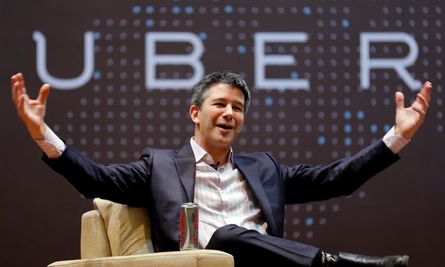
Travis Kalanick speaking to students in Mumbai in 2016. Photograph: Danish Siddiqui/Reuters
In the vast number of Silicon Valley success stories, Uber’s ascent stands out not just for its quick rise but for the brazenness with which it disregarded the law, skirted regulations and operated in the shadows. What started out as a revolutionary idea — tap a button, get a ride — quickly turned into a masterclass in corporate deceit, where the rules were treated as just suggestions and the ends always justified the means. This is the story of Uber’s early years, a tale of bold lawbreaking, covert operations and the uncomfortable truth that in America, crime often pays — especially when you have enough money, power and a loyal base of consumers to shield you from the consequences.
The Genesis: A Disruptive Idea Born in Arrogance
The year was 2008, and Travis Kalanick, a brash and unapologetically combative entrepreneur, was still riding high from the sale of his previous startup, Red Swoosh, to Akamai Technologies. Kalanick had a reputation for being ruthless, a trait that would later define his leadership at Uber. His friend, Garrett Camp, a Canadian entrepreneur who had sold his company, StumbleUpon, to eBay, was also in a reflective mood. The two found themselves in Paris on a cold winter night, frustrated by their inability to hail a cab. Out of that frustration came an idea: what if you could summon a ride with the tap of a button on your smartphone?
Camp developed a prototype for a service he called “UberCab,” and Kalanick, initially hesitant, soon joined as the CEO. Together, they recruited Ryan Graves, a young and eager operations manager, to help build the company. Graves, who would later become Uber’s first employee and head of global operations, famously won his position by responding to a tweet from Kalanick seeking “entrepreneurial product managers.”
By 2010, UberCab launched in San Francisco, offering a sleek, app-based alternative to the city’s notoriously unreliable taxi services. But from the very beginning, Uber’s founders knew they were stepping into a regulatory minefield. Taxi commissions, long entrenched in their monopolies, were not going to give up without a fight. What followed was not just a battle for market share but a calculated campaign of deception, defiance, and outright lawbreaking.
The Ghost App: Greyball and the Art of Deception
As Uber expanded to new cities, it quickly became apparent that regulators and law enforcement officials were not going to roll out the welcome mat. In many jurisdictions, Uber’s operations were outright illegal, as it lacked the necessary permits and licenses to operate as a taxi service. But rather than retreat, Uber doubled down, employing a combination of technological ingenuity and outright deception to stay one step ahead of the authorities.
Enter “Greyball,” one of the most notorious tools in Uber’s arsenal. Developed in 2014, Greyball was essentially a ghost app—a shadow version of Uber’s platform designed to deceive regulators and law enforcement. When Uber suspected that a user was a government official or a competitor trying to gather evidence of illegal activity, the app would serve them a fake version of the interface. Rides would be canceled, drivers would appear to vanish, and the entire operation would remain hidden in plain sight.
The use of Greyball was first exposed by The New York Times in 2017, but its origins date back to Uber’s early years. In cities like Portland, Oregon, where Uber was explicitly banned, Greyball allowed the company to continue operating covertly. When Portland officials launched a sting operation to catch Uber drivers, they found themselves unable to book rides. Unbeknownst to them, Uber had identified their phone numbers and credit cards, effectively rendering them invisible on the platform.
Greyball was not just a tool for evading regulators; it was also used to thwart competitors and even harass journalists. In one instance, Uber reportedly used the tool to block rides to a Lyft executive who was attempting to gather intelligence on the company. The revelation of Greyball sparked outrage and led to a federal investigation, but by then, Uber had already cemented its dominance in the ride-hailing market. The message was clear: if you had enough money and technological savvy, you could operate above the law.
The Illegal Operations: Defying Shutdown Orders with Impunity
Uber’s defiance of regulators reached its zenith in cities where the company was explicitly ordered to cease operations. One of the most brazen examples occurred in Austin, Texas, in 2016. After the city passed regulations requiring fingerprint-based background checks for ride-hailing drivers, Uber and Lyft decided to pull out of the market rather than comply. But while Lyft abided by the decision, Uber secretly continued to operate under the radar.
Using a combination of Greyball and a network of loyal drivers, Uber kept its services running in Austin despite the ban. The company even went so far as to create a fake app called “Tesler” to disguise its operations. Drivers were instructed to use the Tesler app to pick up passengers, while riders were directed to a hidden section of the Uber app to request rides. The covert operation allowed Uber to maintain its presence in Austin until the regulations were eventually overturned.
This pattern of defiance was repeated in cities around the world. In France, Uber continued to operate its low-cost UberPop service despite a nationwide ban, leading to violent protests by taxi drivers. In South Korea, Uber faced criminal charges for operating without a license. And in India, the company was accused of flouting local laws by using unregistered vehicles.
Uber’s willingness to operate illegally was driven by a simple calculus: by the time regulators could catch up, the company would have built such a loyal base of consumers that shutting it down would be politically untenable. This strategy, while risky, proved remarkably effective. In city after city, Uber’s popularity forced regulators to either legalize its operations or risk a backlash from voters. It was a cynical but undeniably successful approach, one that demonstrated the uncomfortable truth that in America, crime often pays—if you’re powerful enough.
The Legal Victories: Loyalty Over Law
Uber’s legal battles were as much a public relations war as they were a fight over regulations. The company understood that its greatest asset was not its technology or its drivers, but its customers. By positioning itself as a champion of consumer choice and innovation, Uber was able to turn public opinion in its favor, even as it flouted the law.
One of the most significant legal victories came in California, where Uber faced a lawsuit from the state’s Public Utilities Commission (CPUC). In 2012, the CPUC issued a cease-and-desist order, claiming that Uber was operating an unlicensed taxi service. But rather than comply, Uber launched a massive public relations campaign, urging its users to sign a petition in support of the company. The campaign generated over 20,000 signatures in just a few days, forcing the CPUC to back down and issue a temporary operating permit.
A similar scenario played out in New York City, where Uber faced fierce opposition from the powerful taxi lobby. In 2015, Mayor Bill de Blasio proposed a cap on the number of Uber vehicles in the city, citing concerns about traffic congestion. Uber responded with a feature called “De Blasio’s Uber,” which showed riders what wait times would look like if the cap were implemented. The feature, combined with a barrage of ads and social media posts, galvanized public opposition to the proposal, forcing the mayor to abandon it.
Uber’s ability to mobilize its user base was not just a testament to its marketing prowess; it was also a reflection of the deep loyalty it had built among consumers. For many riders, Uber was not just a service—it was a movement. By framing its legal battles as a fight against entrenched monopolies and outdated regulations, Uber was able to cast itself as the underdog, even as it became one of the most valuable startups in the world. It was a masterstroke of manipulation, one that allowed Uber to skirt the law with impunity.
Key Players: The Architects of Lawlessness
The story of Uber’s early years would not be complete without mentioning the key players who shaped its trajectory. At the center of it all was Travis Kalanick, the pugnacious CEO whose relentless drive and willingness to bend the rules became both Uber’s greatest strength and its Achilles’ heel. Kalanick’s leadership style was famously abrasive, earning him the nickname “the most combative man in Silicon Valley.” But it was this very combative nature that allowed Uber to navigate the treacherous waters of regulatory resistance.
Garrett Camp, the co-founder and initial visionary, played a more behind-the-scenes role but was instrumental in shaping Uber’s early strategy. Ryan Graves, the company’s first employee and head of global operations, was the steady hand that kept the ship running amid the chaos. And then there was Emil Michael, Uber’s former senior vice president of business, who was known for his aggressive tactics and close ties to Kalanick.
Other notable figures included Rachel Holt, who led Uber’s expansion into new markets, and Austin Geidt, one of the company’s earliest employees and a key architect of its growth strategy. Together, this team of mavericks and misfits built a company that would forever change the way the world moves—even if it meant breaking the law to do so.
The Aftermath: A Legacy of Lawlessness
By the time Travis Kalanick stepped down as CEO in 2017, Uber had become a household name, operating in over 600 cities worldwide and valued at nearly $70 billion. But the company’s rise had come at a cost. The revelations about Greyball, the allegations of sexual harassment, and the countless legal battles had tarnished Uber’s reputation and raised questions about the ethics of its business practices.
Yet, for all its flaws, Uber’s story is a testament to the uncomfortable truth that in America, crime often pays—especially when you have enough money, power, and a loyal base of consumers to shield you from the consequences. By operating in the shadows, defying regulators, and building a fiercely loyal user base, Uber not only survived its early years but thrived, paving the way for a new era of transportation.
The Takeaway
Today, as Uber continues to expand into new markets and industries, its early years serve as a cautionary tale and a source of inspiration. It’s a story of audacity and ambition, of risk and reward, and of the lengths to which a company will go to change the world. Love it or hate it, there’s no denying that Uber’s rise is one of the most compelling chapters in the history of Silicon Valley — a true crime narrative of deception, defiance, and the American dream of getting away with it.
Published by The Reeders Block
Discover more from The Reeders Block
Subscribe to get the latest posts sent to your email.
 The Reeders Block