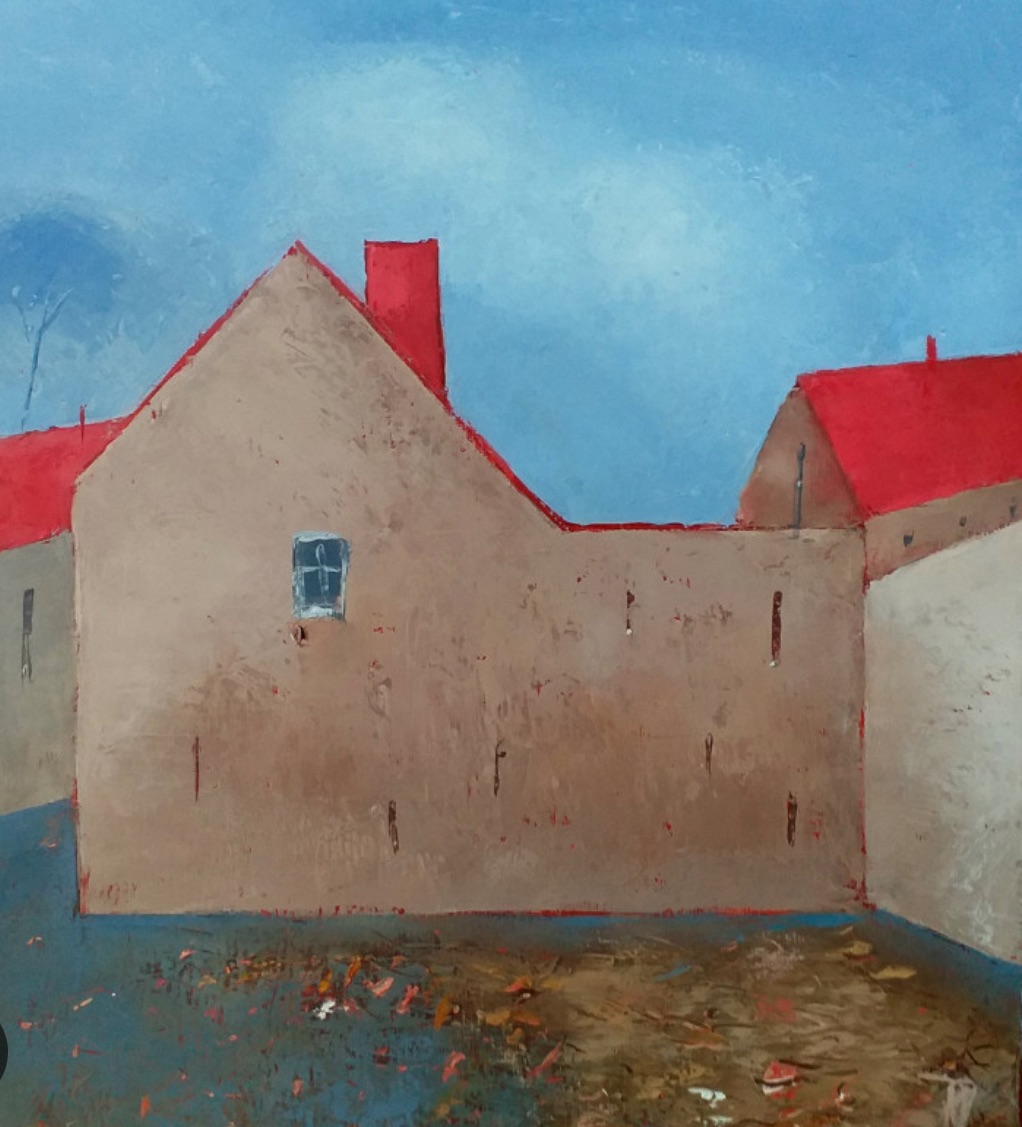
Fragment of the Old Town 6 painting by Kęstutis Jauniškis.
My father always used to complain that I was one of those “damn millennials who doesn’t know his ass from an apple.” He hated the internet, because he said it made people dumber. For me, everything was digital from the news to my friendships. My life revolved around my phone and my ability to connect with the world around me through social media.
The thing that irks me is that when older people speak of Millennials, they tend to refer to us like a product made of the same mold on an assembly line. What separates me from others in my generation is my love for reading and writing. The smell of books always relaxes me.
Four years ago, I took a job as a homecare provider. I was fresh out of high school and I had absolutely no plans to return to any form of school. Each and every night at dinner, my father would say, “When I was your age, Brian, I had two jobs.” And my mom would vigorously shake her head in agreement.
My writing career wasn’t taking off anytime soon, so to show my parents I could keep a job, I became a homecare provider. My father called it “women’s work,” but it was enough to get him off my back. My company assigned me to work for a man named Derek Albright. He was paralyzed from the neck down and, subsequently, bedridden. Every question I asked him about himself went unanswered.
“Look, son,” Mr. Albright said to me one day. “I’m not your friend.”
“I just thought you needed someone to talk to.”
“You get paid to clean my house and wash my ass. Do what you’re good at.”
I didn’t take his rebuke personally. He was a man who could do nothing for himself. I had no clue as to what had left him the way he was, but I was sure that I would be bitter too. So, I smiled my way through ringing mops and sweeping.
Three months after starting my work for Mr. Albright, I came across a manila envelope labeled “All Things Beautiful” while dusting boxes in his attic. An unfinished manuscript written by Mr. Albright peeked out. I propped down on a dusty crate and began to read.
“Brian,” Mr. Albright said, his voice echoing off every wall.
I checked my watch and realized that I had been in the attic for nearly an hour. I reorganized the manuscript and tucked it back inside of its housing.
“What were you up there doing?” he asked. “Dusting doesn’t take an hour.”
“I’m sorry,” I said, looking away from the suffocating weight of his gaze. “I lost track of time.”
“Well, don’t. I’m ready for my bath.”
After getting some water and a towel, I washed him up. There were dark spots on his back, probably from old bedsores. There were also what appeared to be surgical scars near the nape of his neck.
When I got home that night, I could only think of the manuscript I had read. It was a brilliant story about a woman born blind who is eventually given the ability to see. At first, everything to her seems beautiful, but then she begins to see the ailments of the world, from homeless families to starving children.
It had been a while since the last time I had written anything. Mr. Albright’s piece inspired me to pull out my laptop and go to work. No matter how hard I tried though, I just could not find where to start. And then my inspiration drowned away under the reality that maybe I didn’t have what it took to write a book.
“You used to be a writer?” I asked Mr. Albright nearly two months after reading his unfinished manuscript.
There was a long silence, as I swept his bedroom. It was fairly clean, since his overnight care provider usually did much of the sweeping. I made a show of cleaning to give him enough time to respond. When ten minutes passed, I decided to go to the living room.
“You were snooping through my stuff in the attic,” he said, as I was about to leave the room.
Chills crawl through me, freezing me in my steps. His voice is a flat emotionless line too thin to partition off the underlining heat in his tone.
“No. I saw your manuscript by accident.”
“You read it?”
“Yeah. You should finish it.”
“This coming from a snot-nosed kid. I’m a quadriplegic because of one of you punks.”
I let Mr. Albright rant. He cursed his way through telling me that he had been paralyzed when he was run over by a texting teenager. The kid had been let off with a few traffic citations. His jaw drew tighter before relaxing, and then he exhaled.
“Even if I wanted to finish that manuscript, I have no way to do it,” Mr. Albright said, as he closed his eyes for a moment and looked into a place I could not see.
The next day, I came to his home with my laptop, the one I’d used more recently to search the web for nude pics and vids than for actual writing. The chair screeched across the floor as I dragged it into Mr. Albright’s bedroom and plopped down beside him. Then, I pulled up Microsoft Word.
“What do you think you’re doing?” he asked me, the weight of his regular glare pressing into me.
He squinted when I moved my mouth but no words came out. I folded my hands, and the trembling stopped.
“You’re going to tell me your story as I transcribe it,” I said, my eyes not leaving his.
Up until this point, he had never smiled in my presence. But there was a glimmer of something now on the edge of his mouth. For hours, he spoke and I typed. Sometimes he squinted or peered towards the window. Other times, he fell silent for minutes on end. When he spoke, every word matched the emotion down to the inflection in his voice. Inside of the soul of this man lived the distilled, pure essence of a poet. I could have closed my eyes and been in a theater watching a man perform the greatest one-person show in history.
When my laptop died, I finished transcribing with my cell phone. I stopped only to give him water, but I ignored my restroom needs. The story he told was beyond beautiful. After printing the pages at home, I added them to the rest of his manuscript.
For the next four months, Mr. Albright allowed me to read other shorter pieces that he had written. All his stories sparked something in me and made me think beyond what I supposedly knew. They challenged my understanding of the origins of my own biases. It every way, they were resilient. They were not overly depressing, but they were drenched in a sobering reality. They somehow felt so real that when I walked away from them, it was like pulling away from another world.
From his stories, I gathered that Mr. Albright was a brilliant writer who would one day be celebrated. I also came to believe that before living the life of a writer, Mr. Albright had lived many different ones.
“I used to want to be a writer,” I told Mr. Albright one night.
“Used to?”
“It isn’t for me. I can’t tell a good story.”
“Have you ever had a bad experience?”
“Yes.”
“Then you can tell a story.”
Mr. Albright became my writing mentor. I read my pieces to him and he critiqued them. Not once did he hold back. He asked me challenging questions about my characters and my stories. “Every line must have a purpose,” he always said.
I worked for Mr. Albright for another few months before a blood clot caused his lungs to fail. Two weeks after he passed away, Mariana, his nighttime caretaker, showed up at my home.
“Mr. Albright told me to give this to you if anything ever happened to him. He said you would know what to do with it,” she said, handing me the All Things Beautiful manuscript. I thanked her and closed the door.
####
All Things Beautiful was a story that needed to be shared with the world. That is why it was the first story I ever published. And I believe it is the same story that inspired me to become an award-winning author and gave me the strength to show my father who I am. The ups and downs Mr. Albright encountered were uniquely eye-opening, and so were mine. I hope that one day we all appreciate the beauty in the struggles we face. This is why I write.
******
All Things Beautiful (Originally published in 2017 in Third Wednesday Literary Journal), ©️2017, ©2025 by Jermaine Reed, MFA
Discover more from The Reeders Block
Subscribe to get the latest posts sent to your email.
 The Reeders Block