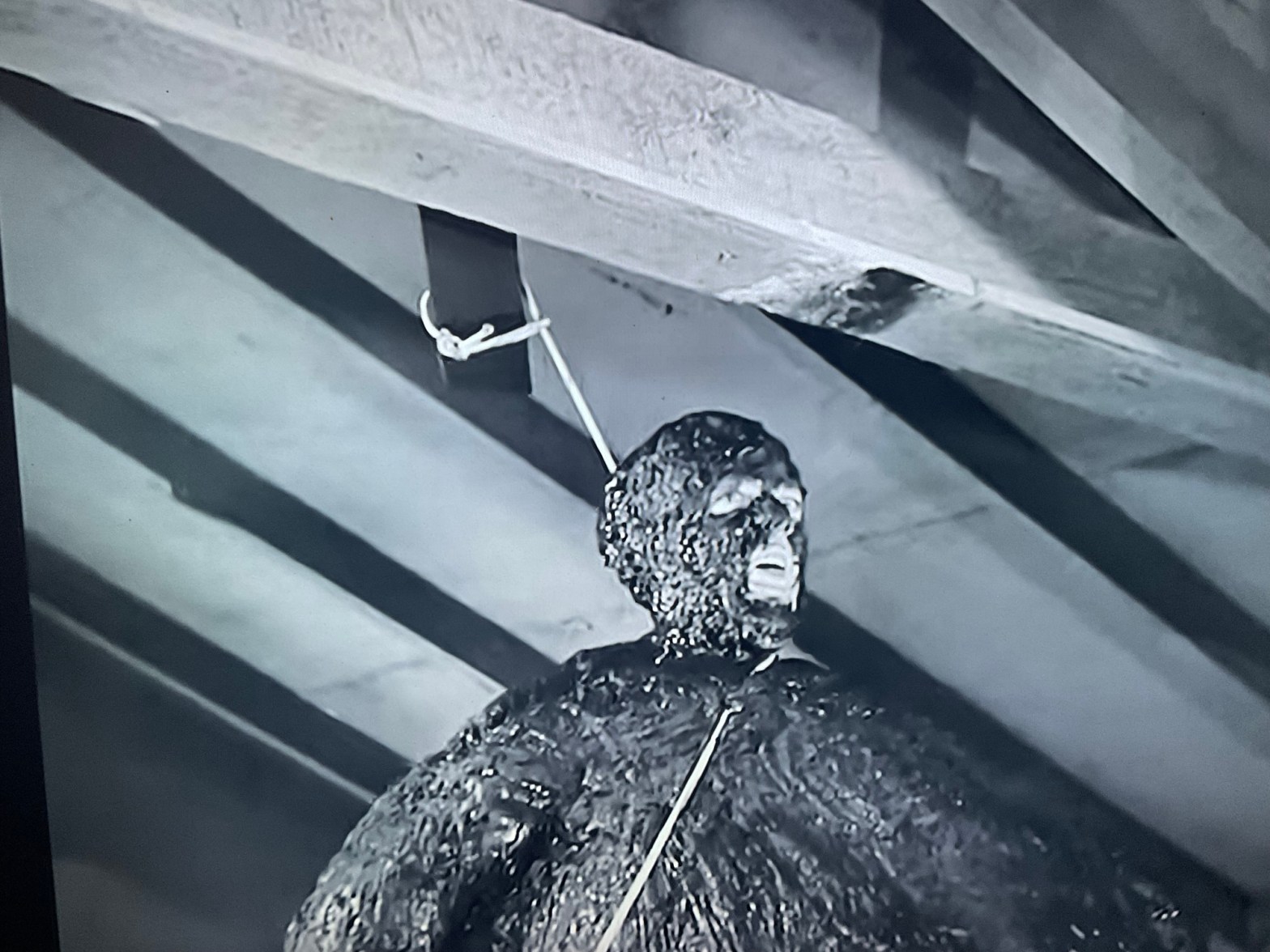
Photo of Moe of Three Stooges covered in black rubber in “Dizzy Pilots”. Screenshot from YouTube.
SUBSCRIBE to get more breaking news in perspective. This article is 100% human-written.
In 1940, Moe Howard of The Three Stooges painted on a “toothbrush” mustache and started shouting gibberish. While the American audience doubled over in laughter, the world watched in shocked silence. It was the first time the sitting dictator Adolf Hitler had been parodied in American film. It was a hilarious and hostile task taken on by the comedic Jewish actor Moe Howard for good reason.
By the time the Holocaust was over in 1945, over 6 million Jewish people had been killed. They had been gassed and tortured in internment camps for years. Because of this and the silence of bigger governments, as it happens in history, it was left to the comedians to draw attention.
Ironically, while Moe Howard was protesting the genocide of Jewish people in Germany, he was also making a mockery of the hangings of Black people in America. Unfortunately, his actions are only a microcosm of a bigger problem that’s been a plague in American film and history since inception. Still, the question of whether it is racism or classism is more complex. America found itself struggling with that question in one of its most racially violent years.
1943
On the evening of June 1943, African American mothers and fathers peered from behind blinds as flames swallowed the homes of their neighbors. Screams and shouts pushed through the night as some families fled, chased by white men with torches. Business owners watched their life’s work be looted by their white coworkers, shipyard welders, boilermakers. When it was all said and done, Black lives, businesses and livelihoods would be taken by men who couldn’t stand the success of another. The drama leading up to the riot had started months before, and The Three Stooges chose sides.
In April of that year, the trio shot the classic short film “Dizzy Pilots.” In the movie, The Stooges are three inventors trying to duck the military draft. They decided to build a military plane instead of doing active duty. WWII was in full effect, and men felt the burden of potential conscription. So, the joke landed in a massive way but carried with it the poison pill of racism.
As The Stooges failed in the spectacular fashion only they can, they found themselves trapped in a loop of hilariously horrific accidents. At one point, Larry is holding a pressurized hose attached to a vat of rubberizing formula. For some reason, they think it’s a great binder for their plane, but they are unskilled at best. It’s a perfect setup for the fallout.
Once the hose is on, Larry loses control and covers Moe in the dark, sticky goo. Tragically, they have no method to get it off. In their usual style, it becomes an effort of trial by error. Ultimately, they use a container of pressurized air that expands Moe’s clothes, causing him to balloon upward. This is where the show takes a dark turn and recontextualizes Moe’s “accident.”

While Moe floats near a wooden beam, Larry and Curly throw together a plan to bring him down. They find a rope and fashion it into a noose. It ends up around the neck of Larry with Curly pulling on the end. After fumbling around, the two toss the rope towards Moe. From the angle, it seems as if Moe is being lynched. It is a sickening image, beyond the borders of repulsive. While some families must have found this to be hilarious, Black families, watching from the nosebleed seats had to be horrified. They had just stumbled through the mind of a drunk controlled by the devilish hands of an unrelenting film studio.
Clyde Bruckman
When Clyde Bruckman sat down to write “Dizzy Pilots,” he was a man at the end of his creativity. He had spent years recycling material that he had written for others because he couldn’t come up with anything new. Sadly, the pen became the release for his rage and self-hate, and the studio became the vessel by which that poison pill was delivered to the American psyche.

Clyde Bruckman was no stranger to controversy, having written years earlier the episode featuring Adolf Hitler as portrayed by Moe Howard. Bruckman was in no way a stranger to moral grandstanding. This makes Moe’s black rubber scene obscenely disturbing, particularly since it is a mockery of a murderous era Black people lived through.
When Moe is suspended in the air seemingly being hanged while also covered in black rubber, it is a poor parody of a Black person being tarred, burned and hanged. In reality, these hangings were torturous barbarity that turned into regular town events. People came from miles around to see, smell and even collect “family heirlooms.” The heirlooms were bones, teeth, charred flesh and hair from the remnants of Black bodies. How would any writer consider a situation like that to be hilarious? How does it make sense for a responsible film studio to produce and disseminate something of such low moral quality and lower intellectual value? This happens a few ways.
Moe Howard was a working man and not one to question the higher-ups. His loyalty to and trust of Harry Cohn made him a prime target. Being President and Production Head of Columbia Pictures, Harry Cohn had unmatchable power and influence. He also had a fierce need to protect the profits of the company.

So, for 23 years, he strung Moe and The Stooges along on one-year short-paying contracts. He’d lure Moe to his office and explain that the Short Film Department was failing. They’d been losing money on The Stooges. But he liked Moe, so he’d do them a favor and sign them one more time. The problem was, it was all a lie.
Not only were shorts making money, The Stooges basically dominated the profits of the department. Without them, the Shorts Department didn’t exist. The Stooges had the keys, but they didn’t have the brain power. Moe was no businessman. He simply wanted to earn his way. He didn’t waste time on negotiating or burn money on lawyers or representation. He and he alone spoke for The Stooges, but he was the weakest voice in the room. Moe’s ignorance mixed with Cohn’s greed and Bruckman’s rage made the “Dizzy Pilots” short an inevitable vector of racial hate. Similar conditions incited the 1943 year of race riots.
The Worker’s Quarrel
As WWII raged on, Black men looked to support their country on and off the battlefield. While some defended the American cause on the frontlines, others worked in factories producing the materials needed for war. Black men found themselves in higher demand and working longer hours, but the work amounted to taking out trash or support roles. Although they had the brains and physique, they didn’t have the opportunity.
During their trials as trash handlers and support workers, their white counterparts welded, built and managed. Their counterparts saw substantially bigger paychecks as well. Generally, this wasn’t an American problem. It wasn’t a problem as all. It was the standard and expectation. That was until a major move by the Federal Government changed everything.
Two years prior in 1941, President Franklin D. Roosevelt signed Executive Order 8802. By 1943, the order was closer to decorative wallpaper than law. While it was written to ban discriminatory hiring in companies with government defense contracts, employers consistently did the opposite. A company called Pennsylvania Shipyard in Beaumont actually did begin a process to integrate Black workers into skilled fields, allowing them to become including welders, burners and shipfitters. As expected, this sent some of their white male coworkers into a jealous, envious rage. The volatile situation was destabilized by one little white lie.
She Too: The Curtiebelle Rogers Lie
The Stooges played into the racial tensions that led to false rape allegations and a riot. “Curtiebelle Rogers” (pseudonym) did too. The 18-year-old daughter of a shipyard worker, Curtiebelle Rogers, had sat at the dinner table night after night listening to her dad’s tales of unskilled Black men taking the jobs of hard-working white men. She’d heard of these Black men being promoted without merit. The system was screwed. And she needed to do something about it. So, she did what was normal at the time: she falsely accused a Black man of raping her. All hell broke loose.
On June 15, 1943, a mob of 2,000 white workers from Pennsylvania Shipyard marched toward City Hall. Incensed by the rape allegations and Black men’s professional success, the mob destroyed everything in its path. The group snowballed into over 4,000 individuals burning hundreds of Black businesses and homes. The economic fallout was immediate.
Black families who had worked decades to build successful businesses and homes watched angry coworkers burn them to the ground overnight. Men who had not worked for shoes, clothes and food made off with barrels of goods that didn’t belong to them. And society forced Black families to carry the bag. The situation was tragic but not unique.
In the span of 12 months in 1943, sailors beat Black men for wearing Zoot suits, Hollywood made a mockery of Black people being hanged and mobs of angry thugs burned Black communities in Detroit, New York and elsewhere. America was a boiling pot of racism and hate crafted by men who ate lobster and steak for breakfast. It was the era that reinforced the racial divide between the working class to further enrich the elites. This was most evident in the interactions Moe Howard had with the lead of the Shorts Department at Columbia Pictures.
The Complications of Class and Contracts
When Moe Howard sat down across from Harry Cohn, he didn’t do so as an equal. He did so as an employee by contract of Columbia Pictures. Moe was just the talent, but Harry Cohn was the power. He was the executive, the suit, the voice and the face of the company. They’d trained him to protect the profits of Columbia, and Moe Howard was just a man trying to make it.

For 23 years, Cohn kept Moe and the rest of The Stooges under one-year minimum pay contracts. Even though the Three Stooges were the flagship of that his department, Cohn did not honor them with higher pay or better contracts. He and Columbia did the opposite. They expanded the operation, increased the profits and kept the Three Stooges where they were concerning pay. However, they did use the Three Stooges as a racial tool of the divide between working class people. Moe happened to be one of those working class people. Today, in our eyes, he and his stooges are movie stars. Back then to the studio, they were nothing. This is the proverbial ball of dung rolling downhill. It further expands the conversation into the intentions of big studios using racially divisive propaganda.
When a writer of a movie chooses to make a mockery of people who have been hanged and burned, what is the point? When they find humor in the complete torture of a group of people, what is going on in the psyche of these people? When does the idea that this is “just art and creativity” get dropped as a pretense? More importantly, what does it say about the American psyche overall?
Today, if someone said they were going to get their family together, grab some snacks and drive out to the suburbs to see a person be tarred, strung up and burned, society would call that person a psychopath. But has there ever been a time in history where it was socially acceptable to do this to a human being and not be seen as a psychopath? When it becomes so normalized that it is a newsworthy event for a family to attend, what is being said about the mental health of the people? These are difficult and troubling questions with shattering implications.
Right now, there are hundreds, probably thousands, of families with what they call heirlooms which are really Black body parts. They are collections of burned skin, hair, teeth and other human anatomy. They are a collection of horrible fates. And they have been passed down from generation to generation, from adult to child. It is a history of sickness, sickness of the deepest kind. It has to be to keep working class people pointing at each other, instead of pointing up at that the real culprit of their situation.
The Black and White of Working Class
Many times, The Stooges found themselves bumbling around the halls of a wealthy socialite. They would enter these homes as the help or exterminators and leave as wanted men. Between the destruction of the homes of elites and being chased out of town, the trio trashed the wealthy. By the end of the film, rich men along with their wives would be covered in pie. The cream of the pie gliding down their faces always serves as a bit of humility in pastry form. On a deeper, viscerally silent level, it is a harsh critique of the rich by the rebel writer.
Clyde Bruckman was not a man of power and little was in his control, other than his pen, and he wielded it like a stealth sword. In the presence of Harry Cohn, Bruckman shrank to ant-size. He took the poor pay of a struggling writer because he had nowhere to turn. Even so, he laced his scripts with the harshest treatments for the elites.
Is the fool the person who burns down a house or the person who paid them to do it? At the end of every Stooge movie featuring elites, the audience walks away with that question. Bruckman portrayed the wealthy in a constant state of pompous naivety. They were the ones who hired The Stooges to build houses when they had no wood. In this aspect, the rich were stupid and cruel. The chip fell off of Bruckman’s shoulder and into his scripts. He couldn’t say it to his boss, but he could say it to the world. Maybe that was more powerful for him, but it wasn’t the cure. His sad end told the world that. But the studio only got bigger, more powerful and even wealthier. What did his small, indirect protests prove or change?
The Takeaway
The Three Stooges dominated American theatre for over four decades, and their studio sometimes used them as tools to spread bigotry. For hundreds of years, sick bigots burned and hanged African Americans. They poured into their communities, looted stores and burned everything to the ground. No insurance companies paid to rebuild those homes. The government didn’t issue subsidies. The country just let it happen. And self-hating writers like Bruckman made a joke of this torturous terrorism. Columbia Pictures gave him the budget, and Cohn gave him the leeway. But Bruckman and The Stooges, all working men, still got financially robbed on the backend.
Even without a raise for over 20 years, Moe Howard chose to ask for a Black costar instead of a raise. By 1955, both his brothers Shemp and Curly had passed away, and Moe knew change had come. Shemp had too, so before his death, he asked that Mantan Moreland be his replacement. Moe tried to make it happen.
By any memory, Mantan Moreland was a legendary performer. Having worked alongside Shemp in the early days, they bonded over packed out shows. Shemp witnessed Mantan bring audiences to tears and to their feet. If the show of The Three Stooges had to go on, Shemp knew Mantan was the man. Cohn shut Moe down immediately. The third Stooge would not ever be a Black man. While Moe didn’t win this battle, it showed the world who he really was.

For decades, Moe took small checks to ensure his brothers always had work. The year Shemp died, he asked the studio to replace him with a Black man. Not once did he complain about his own pay. Moe was no tool of mindlessness. He was a hard-working man with quiet resolve and deep empathy. What he didn’t do for himself, he did for others. There’s a lesson there.
The true war is not between a white welder and a Black man being promoted to one. It is between those men and the system that robs them both to fatten itself. Their true quarrel is with the bureaucrat refusing to cover personal protection equipment, while expecting them to work in factories filled with chemicals from the top down. Bruckman knew this, but in his alcoholic state of self-hate, he couldn’t say it.
By nearly any measure, Bruckman was a weak man. He couldn’t stand up for himself against power. So, he punched up silently in his writing. He did so to bring them down a notch. He punched down to feel a little taller. The further down punched, the bigger he felt. It still didn’t quiet the storm in his soul, the storm fueling and eating away at the conscience of every misguided bigot.
FOLLOW the author Jermaine Reed, Jermaine Reed, MFA for his controversial but real hot takes.
Discover more from The Reeders Block
Subscribe to get the latest posts sent to your email.